



News
Channel Ventilation of Endoscopes
Why ventilate endoscope channels?
The endoscope's channels are ventilated to help dry their internal parts and reduce the risk of bacterial growth.
According to the Public Health Agency of Canada's Guidelines for the Prevention and Control of Infections Transmitted through Flexible Endoscopic Devices, a major factor contributing to the transmission of exogenous microorganisms through flexible endoscopes is the presence of moisture in the channels of the devices.
They cite a 1991 survey by Kazmarek et al. in 1991(84) of stored flexible endoscopes found that 23.9% of samples taken from the devices’ channels had > 105 cfu/channel. Alfa and Sitter in 1991 demonstrated that bacterial growth in the channels of flexible endoscopes during storage was more often associated with Gram-negative microorganisms, rather than Gram-positive microorganisms. They concluded that this growth can be prevented by ensuring that endoscope channels are thoroughly dried.
!n the United States, the American Journal of Infection Control describes an important study in which several tests were performed to understand the impact of various parameters on drying.
In this study, new endoscope test articles that allow direct visualization of internal channel systems confirmed that alcohol rinsing and hanging in a room temperature storage cabinet (a common drying practice are not effective in drying endoscope channel systems).
This result suggests that endoscopes should be dried with compressed air before storage or may benefit from storage in an endoscopy cabinet that provides compressed air directed into the endoscope channels, the study authors conclude.
Adaptaid, a Canadian company specializing in the design and manufacture of medical equipment, is very pleased with the results of this study: "This study confirms the choice we have made as a company to manufacture very high quality products in order to offer our hospital customers equipment capable of protecting patient safety as much as possible," says Sylvie Charette, president of Adaptaid, in an interview with Alliance Métal Québec.
In the MEDISTATIO and MEDISTOR series, Adaptaid offers intelligent storage cabinets that allow for the storage of endoscopes and/or probes in a positive pressure HEPA filtered air environment as well as a compressed air system circulating through the channels. The main advantages of this system are that it reduces the risk of bacterial proliferation and helps maintain the aseptic integrity of the instruments for a longer period of time.
How does endoscope ventilation work?
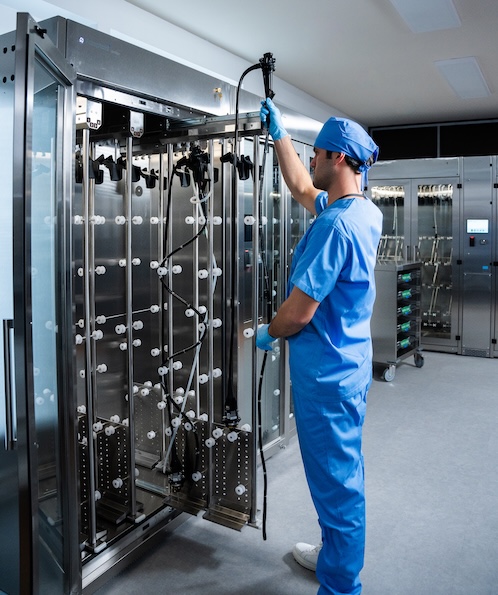
Channel drying can be achieved by placing the cleaned endoscopes in a cabinet with HEPA-filtered air and channel connectors. On the one hand, the continuous positive pressure of the cabinet ensures that the outside of the endoscope is dried and, on the other hand, the channels are purged of internal moisture by the air pushed through the channel connectors.
Click here to view our endoscope cabinet example.
Hanging the endoscopes
First, the clean endoscopes are placed in the cabinet on a specially designed, flexible, moulded hook to prevent damage during storage.
Connecting the endoscopes to purge the channels
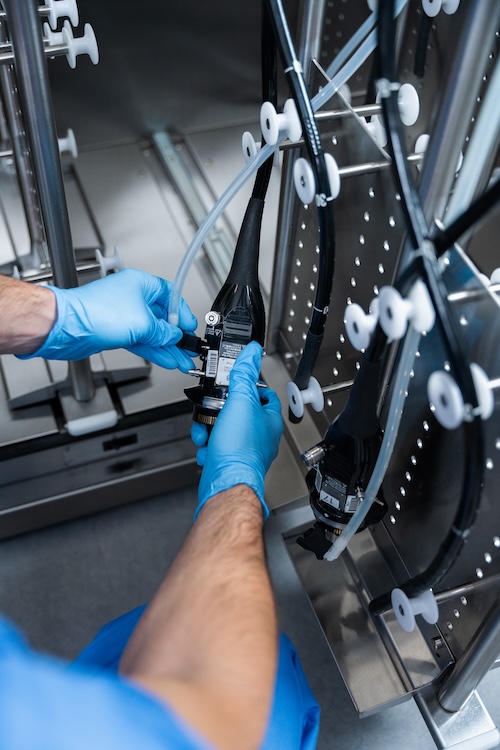
The second step is to connect the silicone tubing to the endoscope to allow HEPA filtered air to pass through all channels. Each connector is specifically designed for each port on the endoscope.
All connectors are flexible and attach with a simple push to avoid damage to the endoscope. In addition, a quick-connect fitting allows the tubing to be easily removed from the cabinet when it needs to be reprocessed.
Drying the endoscope channels
Endoscopes placed vertically in the cabinet receive an air flow from the top of the channels and moisture is purged from the bottom. The pressure and flow rate are increased for an initial purge.
After the purge cycle is complete, the air circulation in the chamber continues. In addition, the channels receive cyclic ventilation until the endoscopes are removed from the drying cabinet.
How are endoscopes dried from the outside?
The ventilation in the cabinet chamber is designed to completely dry the external parts of endoscopes. Its ventilation system is independent of that of the channels, which is dedicated to drying the internal parts of endoscopes. The air entering from the top of the cabinet passes through a pre-filter and then a HEPA filter with an efficiency rate of 99.97%. The air flow is uniform from top to bottom.
The ventilation system circulating air within the cabinet helps dry the external parts of the endoscopes stored inside. This ventilation system of the chamber is separate from the one used for channel drying, which is dedicated to drying the internal parts. Air entering the top of the cabinet passes through a pre-filter and then a HEPA filter with an efficiency rating of 99.97%. Air circulates evenly from top to bottom.
How do I know if the ventilation is working?
In order to avoid poor ventilation of the endoscopes, an alarm warns the staff in charge of the cabinet when there is no air pressure.
Find more information on the importance of channel drying here: INFECTION PREVENTION AND CONTROL GUIDELINE for Flexible Gastrointestinal Endoscopy and Flexible Bronchoscopy
