



News
How Pass-through cabinets reduce the risk of cross-contamination
Updated on August 17, 2026
How Pass-Through Cabinets Reduce the Risk of Cross-Contamination
Improving Care Efficiency and Patient Safety with the Pass-Through Cabinet
Demystifying the Pass-Through Cabinet
First of all, what is a medical pass-through cabinet?
The term “pass-through cabinet” refers to any storage unit in healthcare facilities where the cabinet is built directly into the wall. The purpose of this wall-mounted design is to make the cabinet accessible from both sides of two adjacent rooms.
This type of cabinet provides a quick and safe way to transport medical supplies, medications, medical devices, or other items.

What Are the Objectives of a Pass-through Cabinet?
First and foremost, the pass-through cabinet is designed to reduce the time medical staff spend walking the necessary distances to retrieve supplies, medications, medical devices, and other materials located in another room.
Given that healthcare staff are often overwhelmed with work, having medical supplies close at hand can be crucial, allowing them to reclaim that precious time that would otherwise be lost and devote it to patients.
Pass-Through cabinets also reduce the risk of cross-contamination by minimizing the handling of patient-specific supplies.
How Do Pass-Through Systems for Endoscopes Work?
When endoscopes are used, they must subsequently be reprocessed. This step requires compliance with established standards and guidelines for the effective reprocessing of endoscopes.
The goal of endoscope reprocessing is to provide a reusable endoscope that is safe for the patient. To achieve this, healthcare facilities use best practices for pre-cleaning, cleaning, and disinfection based on proven methods for endoscope reprocessing.
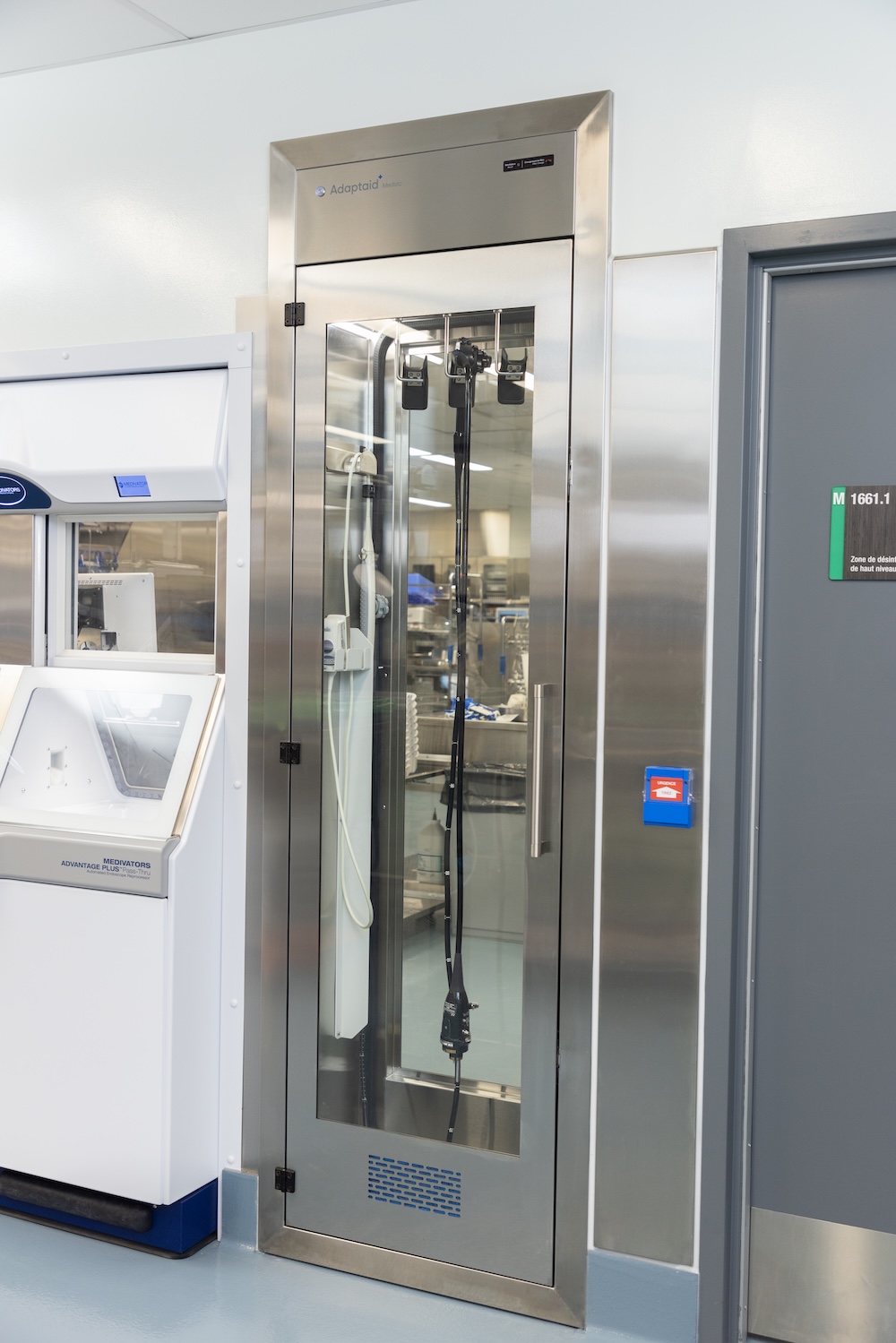
Once endoscopes have been reprocessed, pass-through cabinets are an excellent way to ensure the rapid and safe transfer of endoscopes. It is important to note that improper use, transport, and reprocessing of endoscopes can pose a potential risk to patients and staff of contracting infectious agents through cross-contamination.
How Can the Risk of Cross-Contamination Be Avoided?
One of the best ways to prevent microbial growth after endoscope reprocessing is to use a ventilated cabinet. These cabinets enable forced-air drying, which helps eliminate moisture. Endoscopes can be stored in them for several days, though the exact duration varies depending on the cabinet model used.
Can the Pass-through Cabinet Provide Adequate Ventilation?
To understand how ventilation works in pass-through cabinets, let’s take the MEDISTOR HEPA-ventilated pass-through storage cabinet for endoscopes as an example.
To promote drying, the endoscopes are suspended vertically inside the cabinet. Molded plastic hooks (without cavities) and guides allow them to be arranged individually without coming into contact with other endoscopes.
To dry the exterior of the endoscopes, a continuous, pressurized, HEPA-filtered airflow circulates through the cabinet.
In addition, a second ventilation system generates an airflow that circulates through each endoscope to dry the internal channels.
Can Endoscopes Be Tracked Using Pass-through Cabinets?
MEDISTOR Pass-Through cabinets are equipped with an endoscope traceability system that provides a variety of useful information. This includes the endoscope users, the personnel responsible for reprocessing, the date of disinfection, data on the drying and storage cycles, and more.
The data collected provides healthcare facilities with relevant information for management reports, service improvement, instrument lifespan and maintenance, training, and more.
Traceability helps prevent errors and optimizes the workflow critical to the safety of endoscopes and their users.
Traceability in the Digital Age
On the MEDISTOR Pass-Through cabinet, a digital display provides a visual interface that speeds up access to information relevant to endoscope traceability. A color-coding system identifies endoscopes based on their storage and drying duration, thereby promoting efficient rotation of these instruments.
Specifically, the interface shows users which endoscopes are ready for use, which are nearing their storage limit (yellow code), and which require reprocessing (red code).
Furthermore, endoscope security is ensured by the user interface, which restricts access to authorized personnel. Thus, only authorized medical staff can open the Pass-Through cabinet.
We can conclude that Pass-Through cabinets offer several advantages for patients, medical staff, and care units. These drying and storage units reduce the number of trips and the transport time required for staff to retrieve the equipment they need.
As we’ve seen with endoscopes, reducing transport minimizes the risk of damage, especially since handling these instruments less frequently also reduces the risk of cross-contamination. Ultimately, using pass-through cabinets is safer for patients while making the work of healthcare staff easier.
Would you like to learn more about pass-through cabinets? Contact us!
